Average Reviews:

(More customer reviews)Note: This product is not the first generation product as advertised. The EL520A has many of the features of the 2.0 european version - like the ability to recognize stairs, etc.
I have had this product for almost a year and have used it twice a week to clean. The device cleans with no problems. It seems to pickup everything that it runs across. In a closed room, it works 110% - it will hit every part of the room with no problem. If you have an open floor plan like I do - the device might miss some spots because it does not really know where the room starts and ends - so in this case, it is not perfect.
The unit is kind of heavy which makes me not bring it to other floors in my house. I would love to buy a 2nd unit, but I am and have been waiting for the price to drop.
I have the scooba robot and find that their products are not as well put together or designed as the Electrolux. The difference in price alone should tell that story. The software and sensors on teh Elctrolux are top notch - the unit never hits into anything. The scooba bangs into my furniture and then turns. The EL520A stops about 1/4 inch away - very nice.
The last thing I would like to see is a scheduler as having it start up every morning after I leave and find its way back to the charging station would be a better situation. All in all, interesting product that I think would be even better if it were just a little less expensive.
Click Here to see more reviews about: Electrolux Trilobite Robotic Vacuum
Product Description:
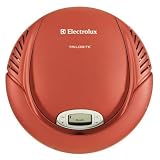
Imagine pushing a button, walking away, and having clean floors an hour later. That futuristic scenario is now here with the Trilobite, the hands-free, "intelligent" robotic vacuum first introduced in Europe by Electrolux. While it isn't the first robotic home vacuum, the Trilobite is a major leap in home robotic technology--one that is reflected in its price. Where other small, round semi-autonomous vacuums are essentially "dumb" robots that randomly move about a room, the Trilobite uses a type of radar that maps a room and then plots a course based on previous cleaning travels.
Evolution in Revolution
The name comes from the hard-shelled sea creature from the Paleozoic era (betwen 250 to 560 million years ago) that roamed the ocean floor during, feeding on particles and small animals. Sound familiar? Today's Trilobite has been in the works since 1997, when its prototype was introduced on the BBC technology program, Tomorrow's World, and it has been perfected at Electrolux's development facilities in Sweden.
The round, red Trilobite uses ultrasound technology to see obstacles and avoid them. Much like a bat, which emits a high-pitched sound to create a personal sonar reading of its landscape, the Trilobite pings 60,000 Hz ultrasound vibrations at surfaces to create a map of the room and remember it for future assignments. This computer processing power is what raises the Trilobite's profile over the competition, whose vacuuming robots can only react to a situation (such as bumping into something) and cannot store data into memory.
The Trilobite in Action
The Trilobite mapping a new room. Start the Trilobite by pressing the power button and answering yes to the question, "Start cleaning?" that appears on its LCD screen. The Trilobite then moves to the nearest wall, following along the edges of the room to create an inner picture of the room. This wall phase (the Normal mode of operation) forms the basis for calculation of the time required for cleaning of the open spaces that follows. The sonar detects any obstacles--blocks left on the floor, chair legs, a dog's water bowl--and a new path is quickly calculated. Transition between hard floors and carpet takes place effortlessly.
The Trilobite also offers two other operation modes. The Quick mode, which is good for a small room or last-minute tidying before the in-laws arrive, skips the wall measurement and moves about the room randomly for around 20 minutes. If you've just dumped a bag of flour on the floor or the kids have tracked an inordinate amount of dirt in from the backyard, the Spot mode can concentrate on an area about 3 feet (1 meter) square, covering every part in a maze-like pattern. You can also choose to clean via a timer for up to 60 minutes.
An infrared sensor detects changes in elevation of four inches and greater to help it avoid falling down stairs. It also comes with special magnetic strips that can be placed in doorways, other openings, or elevation changes less than 4 inches to provide boundaries. The Trilobite can analyze and solve problems it encounters. For instance, if the unit vacuums up a sock left on the floor which stalls the brushroll, the unit will stop, reverse its brushroll to expel the obstruction and then continue with its task once the brusroll is once again operating freely.
It carries two environmentally friendly nickel-metal hydride batteries (NiMH) batteries on board, switching to the second as the first runs low on energy. As the second battery's power dips below the 50% point, the unit will cease vacuuming, return to its docking station, charge for about two hours, and return to the point where it ceased vacuuming to complete the task. The recharging dock fits along the base of any wall within 6 feet of a power outlet.
Weighing 11 pounds, the Trilobite measures 13.8 inches in diameter and 5.1 inches in height--enabling to easily maneuver underneath beds and low coffee tables. It can clean bare floors, hardwood floors, carpets, and rugs. It features 4 motors (one for each of 2 driven wheels, the brush roll, and the vacuum suction), micro filters, and a 1.1-quart reusable dust box (no bags required). With regular use, the dust box will be able to handle one day's worth of cleaning. The EL520A model comes in Cayenne Silk. --Agen G.N. Schmitz
What's In the Box
Trilobite vacuum; battery charger; micro filters; magnetic strips; magnetic strip holder.

Want to read more honest consumer review about Electrolux Trilobite Robotic Vacuum now ?

0 comments:
Post a Comment